Science: Biology
1.2.3 Transport and Exchange Surfaces
Exam Board: AQA
Diffusion
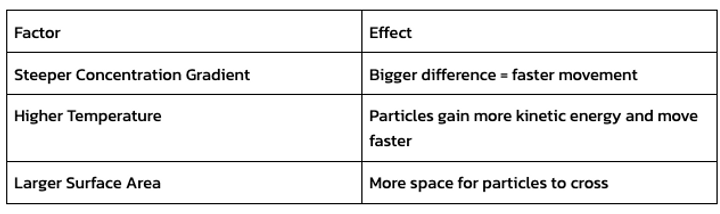
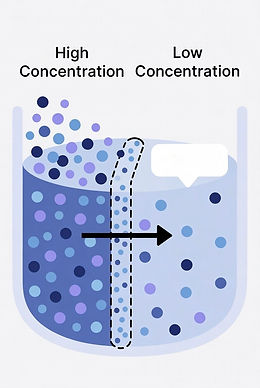
• Diffusion = movement of particles from high → low concentration
until balanced (equilibrium).
• No energy needed — happens automatically.
Examples:
• Oxygen into cells during respiration
• Carbon dioxide out during gas exchange in lungs
• Urea from cells into blood (for kidney removal)
Surface Area to Volume Ratio (SA:V)
• Small cells = high SA:V → fast diffusion → no special systems needed
• Large organisms = low SA:V → need exchange organs
Calculation Example (Cube):
Side length = 2 cm
• Surface area = 6 × (2×2) = 24 cm²
• Volume = 2×2×2 = 8 cm³
• SA:V = 24:8 = 3:1
Compare:
• 10:1 → smaller organism (better exchange) - can rely on diffusion alone
• 3:1 → larger organism (needs lungs/gills) - diffusion isn’t quick enough so needs specialised exchange surface
Exchange Surfaces in Nature:
“How is X adapted for exchange?” — Answer Formula
1. Large surface area due to [villi / alveoli / etc.]
2. Thin membrane (one cell thick) → short diffusion distance
3. Good blood supply (animals) → maintains concentration gradient
4. Ventilation (lungs) → keeps air moving
OSMOSIS
Osmosis = movement of water from a dilute (weaker)
solution to a concentrated (stronger) solution across
a partially permeable membrane until balanced.
Common 3 marker on the exam.
• Only water moves — no other particles.
• Partially permeable membrane = lets water
through but blocks larger molecules.
An example of one of these is a cell membrane.
Analogy:
Imagine two rooms connected by a door that only lets water droplets through, not people. Water flows from the crowded room (concentrated) to the empty one (dilute) until both are the same.
Required Practical 3: Test how different salt/sugar solutions affect potato mass.
There is a common calculation you need to be able to do in the exam in relation to this practical:
% Mass Change Calculation
(Final mass − Initial mass) ÷ Initial mass × 100
Example:
Potato starts at 5 g → ends at 6 g after soaking in water
(6 − 5) ÷ 5 × 100 = +20% gain
ACTIVE TRANSPORT
• Active transport = movement of particles from low → high concentration (against the gradient).
• Requires energy from respiration.
• Used when cells need substances in higher amounts than outside.
Imagine it’s like a cyclist going up a hill, he would be required to pedal and have lots of energy to pedal against the steep gradient.
Examples:
• Root hair cells absorb mineral ions (e.g., nitrate) from soil
• Small intestine absorbs glucose from digested food into blood
Diffusion vs Osmosis vs Active Transport — Summary Table